.png "深圳市创雄科技有限公司")
Stand safety precautions and personnel evacuation
In recent years, China's sports industry has developed rapidly, especially in the field of competitive sports, and its position as a major sports nation has gradually been recognized in the world. In terms of mass sports, the State Council issued the "National Fitness Plan Outline" in 1995, which effectively promoted the development of national fitness. The number of sports population has grown rapidly, and people's material life and overall quality of population have been greatly improved. Like the development speed of sports industry, the development of sports venues in Chinese cities has also achieved remarkable results. While pursuing sustainable development in resource allocation in our country, it is worth exploring in depth whether the layout and construction planning of urban sports venues are reasonable, whether the development of mass sports is coordinated, and whether it is connected with the overall urban planning. Of course, there is also an important point, which is whether the load-bearing capacity of stands meets safety requirements, which will be a long-term and in-depth research topic for stand production units. Now let's explore the consequences of safety hazards in the stands for the audience, and their severity is worth pondering.
At around 8:10 pm on February 17, 2022, a seat collapse accident occurred at the Chongqing Station of Wang Fei's tour concert held at the Chongqing Olympic Sports Center, resulting in at least 64 audience members being injured, including multiple fractures.
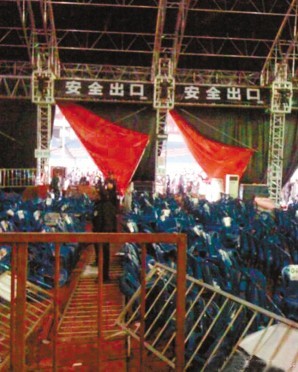
According to on-site reporters, the concert stage is set up on the large lawn inside the Chongqing Olympic Sports Center Gymnasium, and the audience seats are also on the lawn. They are supported by scaffolding, covered with wooden boards, and then densely lined with plastic chairs, about 1 meter high from the ground. The concert starts at 8 o'clock and around 8:10, Wang Fei is about to enter. At this moment, most of the audience stood up excitedly and cheered for Wang Fei's entry. According to the introduction, it is possible that the overall standing and sitting of the audience caused the seat scaffolding to shake and then disperse. From the perspective of the cause of the accident, there are many people in the stands and there is a lot of movement. In the early stage of design, we need to conduct a bearing capacity analysis of all dangerous points and provide a certain safety factor.
Green Frog Company verifies the safety and strength hazards in the grandstand structure based on its own situation, and uses the national standard universal 3D software solikworks to establish a 3D model. Embedded simulation is used for finite element strength calculation and displacement analysis. The material is basically Q235A, with a density of 7.85X10³kg/M3, an elastic modulus of 206Gma, and a Poisson's ratio of 0.3. The yield strength is taken as 220.6 MPa, as CO2 shielded welding is used, and the allowable stress of the weld seam is 115 MPa.
Performance indicators of the seat:
1) Seat material and performance: The seat is made of hollow structure using high-density polyethylene blow molding process or high-density polypropylene injection molding.
2) Mechanical properties: elongation at break>200, static load test seat surface 1600N, backrest 760N have passed 10 experiments, seat surface 950N, backrest 33N have passed 100000 joint durability tests, seat surface impact height 240mm 10 times, backrest impact height 330mm angle 48 degrees 10 times qualified.
3) Flame retardant performance: Oxygen index>21, reaching B2 level.
4) Anti aging performance: the discoloration rating of appearance color is greater than 3.
5) Weather resistance: No appearance changes such as cracking, spots, bubbles, or obvious deformation after 72 hours at+80 ℃ high temperature. At a low temperature of -20 ℃ for 20 hours, there were no local changes, cracks, spots, bubbles, or obvious deformations in appearance.
Our steel stands are all designed with universal standardized modules, greatly reducing the difficulty of installation and production. The appearance is treated with electrostatic spraying. The aluminum seat plate is formed by die extrusion, and the strength is analyzed by finite element analysis using software and subjected to destructive experiments in practice, all of which can meet the requirements.
The pursuit of innovative design and the promotion of the use of new materials in modern sports venues may require an increase in the area of fire compartments, which often leads to difficulties in effectively separating fire compartments inside sports venues. From the perspective of personnel evacuation, extending the evacuation distance to a safe location has increased the number of evacuees, making the evacuation design that must be considered in sports venue design more complex. In order to achieve an acceptable level of safety for people, it is necessary to conduct specialized personnel evacuation analysis for venue design. In fire performance-based design, calculation and simulation methods are usually used to evaluate the safety level of the design scheme. Sports venue buildings designed and constructed according to current building fire prevention regulations cannot guarantee that they fully meet the current level of safety. For example, the current "Code for Fire Protection Design of Buildings" (hereinafter referred to as the "Code") requires that the number of people using each stand exit in a sports arena be between 400 and 700. In order to ensure that the audience hall and stands can be evacuated within 4 minutes in a sports venue with more than 5000 people, the maximum number of people using a 1.65m wide stand exit should be 41 x (1.65/0.55) x 4=492 people. In the Building Regulations, it is only required that the sum of the widths of all longitudinal walkways connected to the stand exit be greater than or equal to the width of the stand exit. However, existing designs often result in varying numbers of users provided by different vertical walkways. At the beginning of the evacuation, multiple longitudinal walkways were able to provide sufficient pedestrian flow, allowing the stand exits to reach their maximum capacity. But soon, with the decrease in foot traffic provided by the less frequently used vertical walkways, the foot traffic at the exit of the stands also decreased. The longitudinal aisle with a large number of users has a longer duration of pedestrian flow due to the inability to effectively transport personnel to the stand exit or other aisles. The uneven flow of people maintained by this longitudinal aisle results in the inability to fully utilize the capacity of the stand exit. The ultimate control point for the evacuation time of the stands is the longitudinal aisle with a relatively large number of users, and its actual evacuation time will be greater than 4 minutes, which is often overlooked by traditional evacuation designs. The effective method to solve such problems is to simulate and model the specific design scheme of the grandstand, and use computer dynamic simulation of grandstand evacuation scenarios to find the problem and solve it, achieving an acceptable level of safety.
Common methods and applicability of personnel evacuation analysis in performance evaluation
1.1 The empirical formula method is widely used in North America, the United Kingdom, Sweden, and Oceania, using the evacuation analysis algorithm based on effective width and density velocity models proposed by Pauls&Fruin et al; The evacuation analysis algorithm based on effective flow coefficient proposed by Japan's "Refuge Safety Inspection Law". The characteristics of empirical formula algorithm are: fast calculation speed, easy to master and use, suitable for analyzing evacuation capacity and predicting evacuation time in structurally simple places. But it cannot describe the details of human behavior during the evacuation process, and the calculated results for complex building structures may deviate significantly from the actual situation.
1.2 Dynamic simulation method in architectural design, the rotation and corners of evacuation channels, the number and slope of stairs will all have an impact on the evacuation analysis results. For evacuation scenarios with complex structures, rooms, halls, and passages are interconnected and intersect with each other, resulting in a significant increase in degrees of freedom during the evacuation process. This makes evacuation analysis very complex, and in some cases, it is almost impossible to obtain satisfactory evacuation analysis results through logical analysis. With the help of computer software, people's actions during the evacuation process can be simulated. The model takes into account building structural factors, personnel type conditions, crowd interaction factors, and even psychological and environmental changes. By integrating multiple factors, it is possible to simulate personnel evacuation in specific scenarios and obtain more reliable evacuation analysis results, achieving the goal of safety evaluation. As a result, the computer dynamic simulation method is increasingly being applied in the performance-based analysis of personnel evacuation in new buildings. Using computer simulation of personnel walking inside buildings to predict and simulate evacuation situations in building design schemes. Currently, countries around the world have conducted extensive research on personnel evacuation dynamic simulation technology, with over twenty types of evacuation dynamic simulation software developed or under development.
The layout of the spectator stands in the sports hall should be selected based on various factors such as the project and usage characteristics, evacuation methods, visual quality, and the shape of the sports hall
1. The stand design should provide good visual conditions and safe and convenient evacuation conditions for the audience.
2. The layout of the stands should be based on the competition venue and sports events, so that the majority of seats are located in positions with short viewing distance and good orientation.
3. The number of consecutive seats between the vertical aisles of the audience should not exceed 30 per row indoors. When only one side has a longitudinal aisle, the number of seats should be halved.
The height of the grandstand railing should not be less than 0.9m; railings should be installed on at least one side of the horizontal aisle of the grandstand; When the height difference between the front and rear rows of the grandstand is 0.5m, railings and handrails should be added to the longitudinal aisle. When using seats without backrests, it should not exceed 10 rows, and if it exceeds, a transverse aisle or railing must be added.
Visual design of the grandstand:
a, The viewing angle of the seat should be controlled within the range of 25 ° to 30 °.
b, When the inner edge line of the stands (referring to the first row of audience seats) is not parallel to the edge line and end line of the competition venue (referring to the trajectory line of the viewpoint) (i.e., the distance is unequal), the horizontal line of sight for the first row calculation should be taken as the minimum or smaller value.
c, For comprehensive competition venues, the project that occupies the largest amount of space should be used as the basis, or the main project's venue can be used as the basis, while taking into account other factors appropriately.
d, The viewpoint position of the stands should comply with regulations.
With the improvement of people's living standards, the construction of sports venues in China is in a good period, with the scale and quality of development surpassing ever before. National fitness activities are flourishing in various provinces, cities and districts across the country. The construction of sports venues also relies solely on national funding. More and more small and medium-sized venues are being built by districts and counties for regional sports events or national fitness. In the process of designing the stands of such small and medium-sized sports venues, we try to minimize investment, use new technologies to improve efficiency, reduce costs, and form optimal designs while meeting functional and safety requirements and highlighting their characteristics. Looking to the future, with the rapid development of the sports industry, the requirements for stands are constantly improving. Green Frog Company will also take innovation in stands and meeting customer needs as its sacred mission. We insist on being customer satisfied, improving customer dissatisfaction, and striving to become an industry benchmark!